
The Old Horn
One saxaphone and a line through time

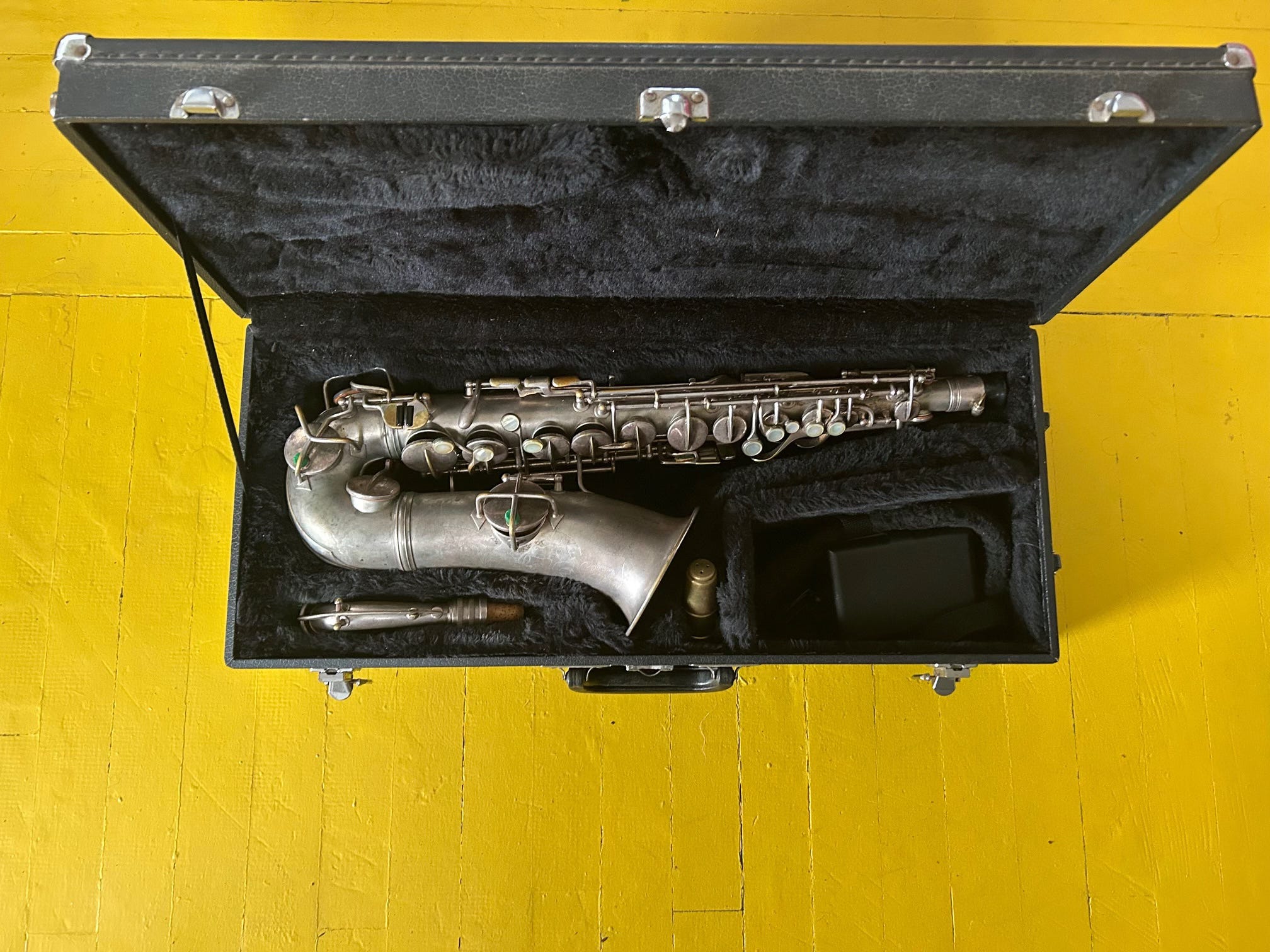
With time-softened reverence, I unsnap my battle-scarred saxophone case.
The instrument inside is old, made in 1927 by the legendary G. G. Conn Ltd. of Elkhart, Indiana, in its Wonder Series 11 Alto Saxophone line. And it is beautiful, with its silver-plated body engraved with floral scrollwork, its mother-of-pearl key touch pieces.
For no apparent reason, the instrument line is nicknamed after the American saxophonist Leon “Chu” Berry, though he never played it himself. Lots of sax giants did, including Johnny Hodges and Benny Carter, who must have loved its big, resonant tone that soared over the big bands in which they played.
I own some old recordings on which they may play the same model of horn I own, which is cool.
What I like even more is that it was once my grandfather’s, who I never talked with much.
John Briers was born in Lancashire, England, into a family that had worked the English collieries back to the 1700s.
So, after his family emigrated to Canada, he entered the Cape Breton coal mines at 11, a trapper boy who sat in the damp and dark--in tunnels sometimes no higher than the under-space beneath a kitchen chair-- where he opened and closed ventilation doors so the miners had air to breath.
It is hard to think of a child who may have still believed in Santa Claus, down in the depths, alternatively bored and terrified, working his 10-12-hour shifts.
Yet from what I know of the man, that wasn’t why he walked into a recruitment station in Truro, N.S., on March 7, 1916, and, at the age of 16, signed up to do his part in the bloody war of attrition underway in Europe.
From documents on file in Canada’s National Defence headquarters we know that Jack Briers was a practising Anglican with a Grade 5 education. His hair was brown, his eyes blue, his complexion “fresh.”
From the same source we learn the he was five-feet-eight-and-three-quarter-inches tall. Despite five years in the pit, his lungs and heart were healthy, all his limbs worked and that “he was not subject to fits of any description.”
I don’t know exactly when his unit shipped out, just that they crossed from Halifax, N.S. to Liverpool, U.K. aboard the Empress of Britain, and did a short stint in England before leaving for France, to join the 14th Infantry unit of the 3rd Brigade of the 1st Canadian Division.
“The first division of the corps was involved in all major actions of 1916 and 1917,” according to a communication sent to my brother from Canada’s Department of Defence, “two very difficult years which marked the turnaround of the front, after Vimy, and other major victories in 1917.”
This meant that my grandfather fought in the Battle of the Somme, where 24,000 Canadian troops died, and in the Battle of Mount Sorrel, in where 8,000 of his adopted countrymen perished.
The First Division was there in the carnage of Vimy Ridge. They acquitted themselves with honor at the battles of Passchendaele and Hill 70 and did the same throughout the bloody Hundred Days Campaign.
By my calculation, more than 34,000 Canadians died during this fighting, some of the bloodiest of the Great War.
When Jack Briers was discharged on April 20, 1919, the reason given on the form was “medical unfitness.”
We do know that years later, as a married father of three girls in Sydney Mines, N.S., the night terrors would sometimes strike, and perhaps he imagined himself back at Vimy Ridge on the occasion that the German shelling rendered him unconscious, and he awoke tangled in barbed wire.
Back in Cape Breton, he returned to the mines, eventually rising to the rank of inspector during the days of the island’s great colliery labor battles, which meant that on at least one occasion, strikers burned him in effigy outside his home.
Yet, when the Second World War erupted, he signed up again. Jack Briers was 49 then, too old for the front lines, but did his duty at home front where, according to his records, “his musical training was put to good use.”
You see, there was another side to this collier and soldier, a whole other life filled with beauty that maybe gave him some solace from the hard things that he had seen and done.
Jack’s brother Harold had a musical bent, so much so that he went to McGill University in Montreal to study, and later, known as Professor Briers, returned to Sydney Mines to set up as a music teacher.
My grandfather had a facility too. It is a mystery how he learned.
All we really know is that he somehow he came to play the violin, tuba, and French horn. As a grown man, he would breathe life into the organ at the Anglican church he attended on Sunday mornings and, some evenings, at the town’s movie theatre as the silent films rolled across the screen.
When Sydney Mines’ colliery band led a procession to the cemetery, it is my understanding that Jack Briers would be in the lead, the mournful notes emerging from the bell of his clarinet into the Atlantic air.
At dances at the North Sydney yacht club, he would stand ram-rod straight in a white suit jacket, blowing his alto sax in a manner memorable enough that, half a century later, a friend’s mom could still vividly describe what he looked and sounded like on those long-ago nights.
Some years later, weary of my regret about never having learned to play an instrument, my wife called my aunt, who had inherited the alto. In the winter of 1988, it arrived in Toronto, where it was refurbished and appeared under the Christmas tree.
Since then, I have been playing it in in fits and starts, maddening neighbours, frustrating teachers.
For a short time, I was part of the woodwind section of an orchestra, even performing in public once. Another time a friend who played in a ska/jazz/rock band invited me to jam, an invitation that was never repeated.
I’m back at the sax again now, my new post-punching-the-clock life being the perfect time to make some real headway.
Mere competence seems a long way off. But my relationship with the instrument has always been more about aspiration than achievement.
There’s this other thing too. The realization that when I touch its worn mother-of-pearl keys, I am, in a way, touching the fingers of my grandfather.
When I force air into the mouthpiece, my breath travels down the same metal pathway his once did, and where its molecules may still linger, in a way connecting us through time.
Nice to read about the great grandfather I met only a few times
Great article John!
Can't help but think of Natalie McMaster's beautiful song 'Fiddle and Bow' with Bruce Gouthro on vocals.