
Opening verse
An excerpt from an in-progress memoir about a rolicking life: Irish-Canadian folk singer turned entrepeneur and investor, Denis Ryan

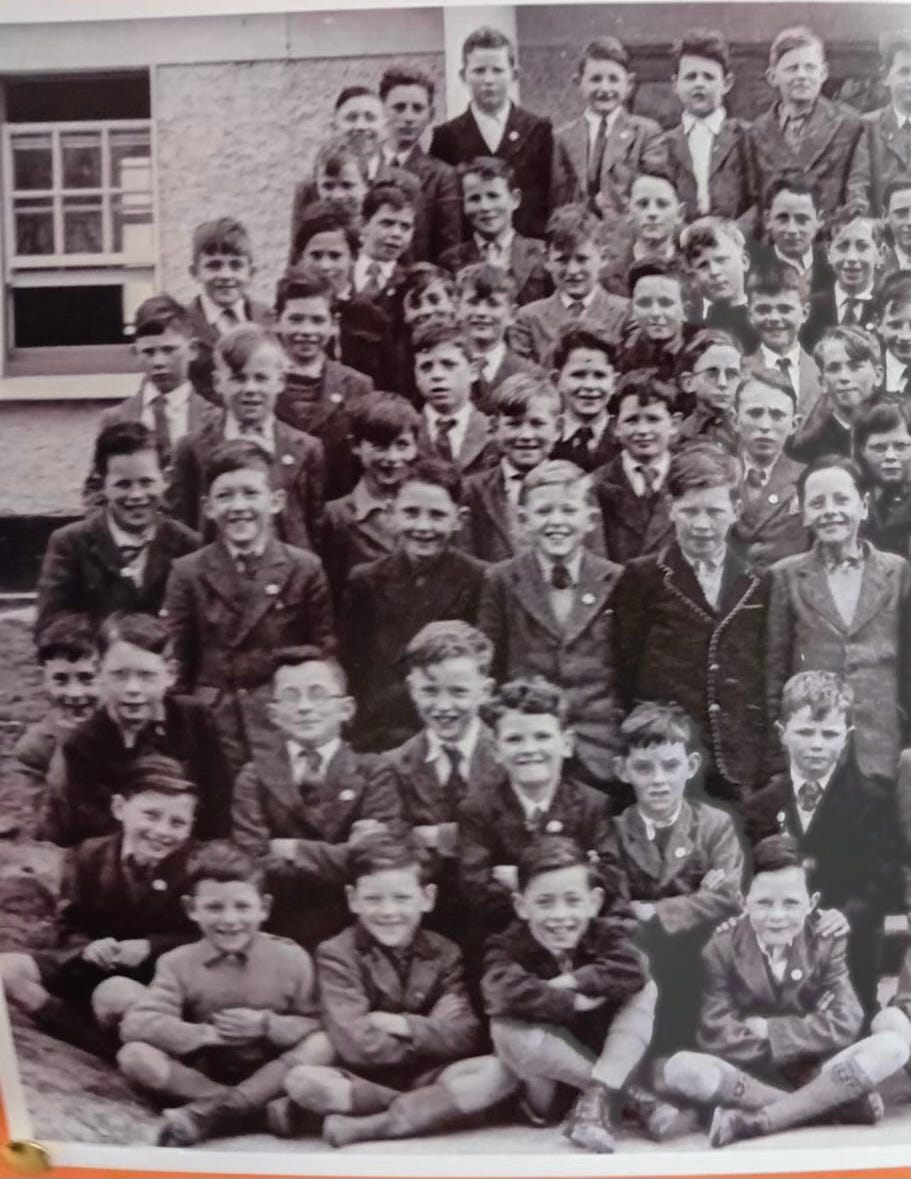
(Ryan—third row from the top, four in from the left—with his mates at his all-boys primary school in County Tipperary.)
Since I only send something this way once a week, you may be asking yourself, just how does this fella fill his days? In part, the answer would be by helping the young shaver pictured above—Denis Ryan, the Irish-Canadian folk musician and Ryan’s Fancy front man, later turned investment executive, entrepreneur and investor—with his memoir.
Now, such a boast may seem suspect since those who type for a living are always supposedly “working” on something. Don’t just take my word for it. Here is actual proof: the first chunk of our collaboration, from a chapter tentatively titled, The Auld Country, which I hope you like.
My life began with a mystery. Not how I came to be born in the fierce cold winter of 1943; as hard as the Catholic Church tried, the people of rural Ireland knew as well as anyone how that worked. But where the blessed event took place. Because every sibling that would follow, John a year later, then Kitty, Mary and the baby, Seamus, were born right there in our small farmhouse with Nurse Ryan, the community midwife in attendance.
I entered the world in the sparkling new Nenagh Hospital, a couple of hours by horse and cart from our village of Newport, in the northwest of County Tipperary. Being firstborn is the only reason I can think of for such special treatment. On the other hand, Jimmy and Mai Ryan were practical people. Eyeing the result—me—maybe my parents resolved to leave future deliveries in the hands of the midwife of Newport, rather than the doctors of Nenagh. After all this time, who is to say?
I do know that the first journey home would have been a rough one, over cobblestone roads that hadn’t changed much since Cromwell’s hateful army marched down them. Through hills and rugged uplands, until you get closer to our spot, when the moors and boglands appear. Then the fields, perpetually green, because of the temperate climate, and because it was always raining—so much so that when it went on long enough that the people began to moulder, the priest would pray to God for it to stop. Occasionally, there were short droughts, a week, even two sometimes. When that happened, the priest would also pray, this time for a downpour, so that the crops would grow again, stopping hunger at the door.
Back in that day, there was no way of telling one farm from the other around here: after the English landlords departed, families, in many cases, were large, 12, 13 or 14 children to a house, so the farmlands got divided into smaller and smaller pieces. Decades later, the farms grew again as family members began to buy each other out. But not in 1943, when the Ryan farm was all of 30 or 40 acres, on top of an elevated hill. In one direction, a mile-and-a-half away, we could see clear to the steeple of The Most Holy Redeemer Catholic Church in Newport, and beyond it, another five or six miles distant, the River Shannon, and the beautiful Clare Hills, over which the clouds would come from the southwest, letting us know rain was on its way.
I know what I would have seen, if a newborn could see, approaching the farm for the first time—beyond the stand of trees on the road, past old Kenna’s house, and the home where the Jones family, with their five or six kids, lived—because it is what you would see now: a roof of slate from the quarry in Portroe, near the River Shannon, breached by a chimney for the smoke from the peat fire; thick rectangular walls composed of stone and clay. The outside was whitewashed, as was the local habit. We hadn’t much, but what we had we looked after and made go far.
Inside, everything had its purpose and its place. Especially in the kitchen and dining room, all in one, which served as the centre of the house. For the first decade of my life--before electricity arrived and we somehow put together enough money for an oven range--an open fire always burned there, over which my mom would hang the big iron pot where she did the cooking. From there it was only a few steps to the bedrooms, my parents, but also my dad’s mother, Mary, who suffered a stroke down one side and half of the other, and needed to be looked after for the rest of her days. For the first bit, when I was just a baby, I presume that I had a room all to myself, but when the others came along, we had to double up, the boys in one, the girls in another, sharing beds. Poor Seamus, the littlest lad, got the worst of the arrangement, laying down at night between John and I, his head keeping company with our feet.
I pitied him for that, but luxuries were rare in our house. We never went hungry: breakfast being porridge from our oats and an egg from one of our hens, and maybe a piece of bread made by our mom’s hand. The noon-hour meal for six out of seven days was the hardy vegetables we grew ourselves. Supper was something light: a cup of tea, a hunk of bread, maybe another egg. We drank milk from our cows and water from the well. The only thing store-bought was the loose tea—our favorite was and is Barry’s tea from Cork-- that would brew in the pot day-long until it was thick enough for a mouse to walk across.
We were like everyone I knew in Tipp in another way: no indoor plumbing. Toilets and sinks arrived in the early 70s. But before that, all of the bathing took place in a portable aluminum tub placed in the middle of the kitchen, with water heated over the fire. In the kitchen, my mom washed clothes by hand on a washboard. If the weather was mild, the washing was hung outdoors to dry. If not, the clothes would dry by the peat fire, and later, the peat-fired Stanley stove.
The clothes were dirty because of the long hours spent among the cattle, horses and pigs. The dust coating dad’s boots came from the tilled ground where we grew hay to feed the cows, and all manner of veg—potatoes, turnips, carrots, parsnips, cabbage and onions—to feed ourselves. The mud from the bogs, where we cut the peat, which we called turf, for the fire, clung to the hems of our pants.
It was hard to stay clean living the rough rural life. Yet, despite our want, we had pride in our hearts, trying to live up to the Ryan family motto, “better to die than bring shame upon yourself.” So, every day we did our level best.
When I say that Ryan is a common name in Tipperary, I mean that if you opened a telephone book anywhere in the world and ran a finger down the page until you came to that name, and then called the number next to it, soon you would be talking to a man or woman whose people, somewhere along the line, came from Tipp. There, God help us, every second person could carry the Ryan name, going back to the 15th century.
Believe me when I tell you that back in 1991, I was playing golf on Easter Sunday at the Southern end of New Zealand. It was a famous course, designed by the legendary New Zealand golfer Bob Charles; I wanted a t-shirt to prove I had actually played it, so, I stepped into the clubhouse where I met the pro.
His name, he said, was Patrick Ryan, which floored me, since my own name is Denis Joseph Patrick Ryan. Now Queenstown, where the course was located, was near a mining community; he told me his grandfather had emigrated for work. Here’s the unbelievable thing: the old fella began his working life in the Tipperary village where he was born—a place called Silvermines, halfway between Newport and Nenagh.
“Take whatever you want,” young Ryan told me, a nice gesture to someone from the auld country who surely, somewhere along the road, was a relation. In exchange, I gave him my sweaty Ashburn golf club shirt from Nova Scotia.
What I mean to say, is that with so many of us around, you can’t go by the surname alone. That’s where the nicknames come in, which explain which family you’re asking about. This will show you what I mean: in 1965 Newport won the Tipperary County Gaelic Football Championship, which is a little like winning the Rose Bowl if you play the inferior game known as American football.
Now, there are 15 players on a Gaelic football team. On Newport’s, seven were named Ryan. Mercifully, each family had its own little nickname: Michael Ryan Lacken, since his people were from that village and also Dinny (Boola) Ryan, so called because he hailed from the townland of Boola, Newport.
The one to watch, Ned Ryan, went by Ned Og--Gaelic for young--perhaps due to his prowess on the field. Although I really have no idea why Harry Ryan, who later in life would become a big one for the greyhounds, was nicknamed Quay.
I was the goaltender on that squad. Out on the field, in my reddish jersey, I was known as Dinny, not, as you might think, because of my first name. Our crowd, to this day, are known as the Ryan Daddies, after my great-grand-dad, John Ryan. He was known as a tough man who could handle himself at village fairs, and maybe after a few pints, making him, in the local people’s way of thinking, the daddy of all Ryans
Sometimes I think about how it was for him and my great-grandmother Mary, living in Newport in the last years of the 19th century. Married just eight years after the close of the Great Famine. Knowing that a crop failure meant starvation because the rents the landlords in England demanded were so high. The air must have been thick with discontent, I would think, the secret societies starting to meet under the cover of night, in barns and pubs, laying the groundwork for the rebellions that followed.
Except most of those in Tipp weren’t out fighting for independence, the way I hear it. They were too busy keeping the crops safe, the rent paid, the little ones fed. Just surviving. Five of my great-grandparents, John and Mary Ryan’s children, stayed in the Newport area, choosing to try to scrape a meagre living out of the land like those before.
The four others had bigger dreams. Somehow, they put together enough money to board a ship, maybe in Limerick or Cobh, County Cork. Amid the rats and dysentery, they made their dismal way across the Atlantic.
I picture them gawking as the boat entered New York harbour, looking up at Lady Liberty, the symbol of everything that the new land had to offer. Why the lot of them didn’t stay in New York City, where so many from Ireland had settled, is anyone’s guess. All that is sure—if anything is sure in this life—is that four of them, Jim, John, Kate and Denis emigrated to St. Louis, Missouri, around 1893.
In St. Louis, from the sounds of it, life took a good turn for Kate, who married a fellow named Hughes, and had two sons, one of whom ended up founding a casino in Las Vegas. John, who never married, was buried in St. Louis. So, too was Jim who married Mary Flavin, from County Kerry.
Although one of their six children died in childbirth, for Jim and Mary, the great days must have seemed to stretch ahead in their new country. But fate stepped in, as if to remind them of who is in charge. Jim had chosen the pipe fitter’s trade. One day, on the job, an electrical wire shook loose and swung down, setting his clothes on fire. Before the flames could be extinguished, he was burned head to foot. An ambulance took him to hospital but he didn’t make it through.
The vengeful old gods weren’t finished with the couple yet. To pay the bills, Mary Flavin Ryan took in boarders at her home. When one let the arrears mount, she evicted him. One afternoon, while she was in the basement doing laundry, he appeared at the top of the stairs. The man, a bricklayer named Costello, pulled out a pistol, took aim, squeezed the trigger, then turned the revolver on himself.
Left orphaned, the five remaining Ryan children were divided up among their relatives. From there the story gets murky, it does, but the broad outlines of it would be fodder for another book, which would make better craic than this one.
I say this because two of Jim and Mary’s boys may have started humbly, in the American Midwest. But the lives of John and Willie Ryan quickly became the kind of thing that filled the pages of the tabloids and pulp magazines of the 1920s and 30s, riveting Americans with stories of gangsters, mob wars, and the criminal underworld.
The Ryan brothers’ business was gambling. Not like betting on the hounds or horses back in the old country either—no, they were into the big action. Behind the front of legitimate business, their gambling houses achieved continental fame, particularly Johnny’s, guarded as it was by steel doors, machine gun turrets, and a staff of gunmen garbed like businessmen in dress suits.
Now remember, this is the Prohibition period we’re talking about, a time when a man after making his way could do well for himself. And both of the boys did, despite the constant attention of the guards who raided their establishments regularly, but never once managed to charge either brother with anything that stuck.
Still, the gangster’s life is not one known for longevity, and a happy old age surrounded by the grandchildren. Willie died by police gunfire outside of his gambling den. His brother went from natural causes in his 40s. Ah, but the row his death started, for Johnny Ryan was a devil for the women as well as the dice. Upon his passing, two ladies claimed to be his widow, and a trio of children joined the scramble for his millions.
“as hard as the Catholic Church tried, the people of rural Ireland knew as well as anyone how that worked…” just killed me. excellent. Onward!!!
I'm hooked. Can't wait to read the rest.